Different leadership styles have various different characteristics such as interpersonally oriented, task‐oriented, autocratic, and democratic styles and that too, differently for both men and women (Eagly and Johannesen, 2001). However, I believe, different leadership styles can co-exist within a society (Cherry and Jacob, 2016), masculine and feminine leadership styles (Bolden et al. 2011), formal and informal leadership styles. You can be a controlling leader with the quality of being careful and supporting. Similarly, you can also be experienced and skilled, take charge as a leader due to access to decision making powers, but not be officially hired by an organisation. Moving forward, the purpose of this piece of writing is to discuss my development as a future leader depending on my performance as leader of a team, my journey and experiences that lead to my evolvement as a leader. Further appraising my leadership brand and justifying the model of leadership that reflects my vision and values about leading other people as a leader in order to achieve successful result and reach my goals.


Serious leaders understand that, both by design and default, they’re always leading by example. Some want to “lead from the front” while others prefer “leading from behind”. But everyone senses their success — and failure — at leading by example is integral to their “leadership brand”. Smart leaders want to build their brands. The lead-by-example stories executives tell sharpen their leadership brand propositions. The true lead-by-example test is who follows those examples and how. (Schrage 2016:2-4). So, what is my leadership brand?
My Leadership Brand:
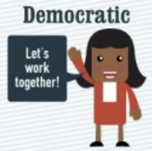
Among the many leadership styles, I believe I have always been a democratic leader. Democratic leadership is theoretically very different from styles such as autocratic or laisezz faire. Democratic leadership involves teamwork, distributing responsibilities equally among everyone, contributing equally to decision-making process and empowering each other (Gastil, 1994). Almost everyone is a leader and a follower. “A limited number of practical and moral considerations are identified for assessing the appropriateness of the democratic leadership model for different groups” (Gastil, 1994).

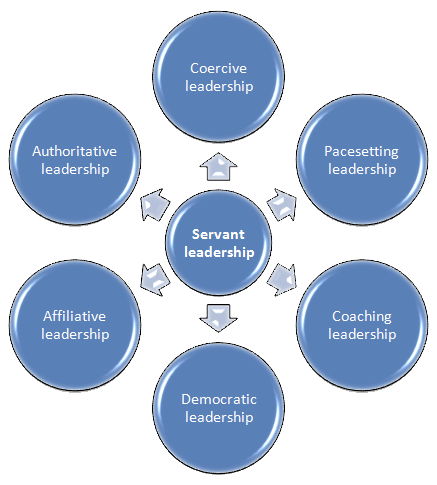
Effectiveness and Implementation of my leadership brand:

According to Grace’s (2006) 4V model, my aim is to implement all the above-mentioned 4Vs that are, Values, Virtue, Voice and Vision. In my leadership style I want to have conviction in whatever I strive for and envision, hence in order to have the right amount of belief, I plan to uphold my values high and unyielded. Such values most definitely require conventional virtue and a strong leader-like voice that must be heard at all times. Following my values and adapting the right virtues, I aim to make my voice heard and reach my vision. It is the kind of leadership that could easily be trusted and supported by my team as it gives them a say in the decision-making process.
My Current Strengths and Demonstration of Own Leadership Style:
Based on the feedbacks provided from my teammates, I find that democratic leadership role fits me perfectly well, since a democratic leader needs to be patient, a good communicator and a good listener. Throughout my last year, I had encountered many projects in which I was ought to deal with utmost patience and calmness and make do with many situations in which I may have reacted otherwise, but with time I have endured the art of patience, understanding and cooperation. My understanding for teamwork and respect towards my teammate is comprehensive. Furthermore, since democratic leadership style requires a team decision making process, I have mastered the skill of listening and giving every single person a chance to present their ideas and speak while decisions are being made. As Adair (1973) mentions, management operations must be distributed to a diverse set of individuals. I believe in this concept, work must be divided equally, without any bias and irrespective of a team mate’s race, culture, nationality etc. A definition of a great leader is someone who achieves unity of common beliefs and directions for his teammates without actually destroying the uniqueness of the fellow (Winston and Patterson, 2006), which I believe I am capable pull off.
Development Plan:
As Kruse (2013) writes, leadership is a process that comprises of everyone’s efforts and work towards the achievement of a common unified goal. My plan to achieve my goals is to firstly unify my interests with that of my team’s interests. Secondly, follow Grace’s (2013) V model and adapt it to my style. Lastly, be a good listener and overcome my weakness such as not being able too flexible about changes; organisational changes are of utmost importance.
Reference List:
Adair, J.E. (1973), “Action-Centred Leadership”. McGraw-Hill, London.
Bolden, R. (2011). Distributed leadership in organisations: A review of theory and research. International Journal of Management Reviews, 13(3), 251-269.
com. (2015). Old vs. New Forms of Leadership – Leadership Skills and Values. [online] Available at <http://www.leadershipskillsandvalues.com/clnontheweb-curriculum/old-vs-new-leadership>>
Cherry, B., & Jacob, S. R. (2016). Contemporary nursing: Issues, trends, & management. Elsevier Health Sciences.
Eagly, A. H., & Johannesen‐Schmidt, M. C. (2001). The leadership styles of women and men. Journal of social issues, 57(4), 781-797.
Gastil, J. (1994). A definition and illustration of democratic leadership. Human Relations, 47(8), 953-975.
Grace, B. (2006) Ethical leadership: In pursuit of the common good. Seattle, WA: Center for Ethical Leadership.
Kruse, K. (2013) ‘What is Leadership’. Forbes [Online] Available at: http://www.forbes.com/sites/kevinkruse/2013/04/09/what-is-leadership/
Schrage, M. (2016) ‘Like It or Not, You Are Always Leading by Example’ Harvard Business Review [online] October 05, 2016. Available from < https://hbr.org/2016/10/like-it-or-notyou-are-always-leading-by-example>
Winston, B. E., & Patterson, K. (2006). An integrative definition of leadership. International journal of leadership studies, 1(2), 6-66.

 Leading in a Changing World
Leadership styles differ from one society to another. This is the same too from organization to another organization. Leadership comes with responsibility, commitment and sacrifices.
Ultimately the goal of good leadership is the betterment of the public in general.
Today society has no place for kleptocracy or autocratic rule. With the advancement and proliferation of the social media and information technology, it is a world of transparency and accountability. Gone are the days of the leadership of dark ages
In this connection, a democratic leadership is still the best for many societies and organizations. Nonetheless democratic leadership has its demerits too, namely the slow process in making changes such as can be seen in the Brexit process.
Be that as it may, it is the only leadership that give voices to the majority.
LikeLike