According to Aristotle’s definition of change, as stated by Kostman (1987), it is a process by which something is actualised. Change is personal, change is making or becoming, transforming, evolving, a process through which one thing changes into another thing.
If a change is to take place in an organisation, the organisation has to undergo various sets of processes, but mostly, it goes through the transitional issues. According to Cummings and Worley (2014), most popular issues of such transitional changes within an organisation include, ambiguity of purpose: the leaders and decision makers responsible for the change most often than not, fail to clearly brief the organisation’s populace regarding the purpose behind the changes. This further leads to high levels of distrust within an organisation, where the workforce feels that the higher authorities are keeping important details from them. This creates an organisational disturbance in the entire work space. Hence, a properly well-planned change management plan is extremely vital for any organisation in case of undergoing any change. According to Burnes (2009), change management is not a very different or unique discipline with finely defined goals and rigid boundaries, in fact, change management is based on traditions and practices of social sciences, for instance, the theory of management learning helps people understand the behaviour of those who learn and manage change.
Problems with change management:
According to Kotter and Schliesinger (2008), changes in some organisations turn out to be disastrous and complete failures, but efforts in some organisational changes lean to success. Nevertheless, most of the times it happens that organisational changes efforts encounter problems; it takes longer than a projected time period and required work, which sometimes destroys morale further costing a great deal in terms of managerial time or emotional upheaval (Kotter and Schliesinger, 2008). This is the reason that many organisations that need changes desperately have not even initiated, the higher authorities and decision makers feared that they were simply incapable of successfully implementing them.

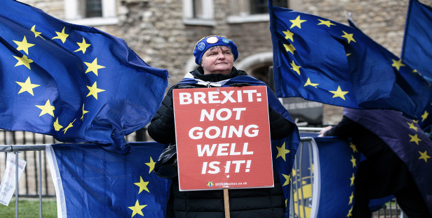
One major change took the business world with shock when on 29th March 2017, the UK officially triggered article 50 of the Lisbon Treaty, paving the ground for the UK’s plans to leave the European Union (‘Brexit’). The triggering of article 50 was historically ground-breaking, and it marked the beginning of a two-year period in which the politicians, businesses and the people of Britain had to prepare for a life after Brexit. Brexit have undoubtedly had consequences for British businesses, and it is believed that London-based businesses were the most affected. However, these consequences might vary from industry to industry, however, many London-based businesses questioned what the future holds for them in the UK.

According to Kierzenkowski, Rusticelli and Zwart (2016), A UK exit (Brexit) has been a huge negative shock to the UK economy. He also assumed in 2016 that in some respects, Brexit would have been akin to a tax on GDP and would impose a persistent and escalating cost on the UK economy, which could be prevented if UK choose to remain a part of EU (Kierzenkowski, Rusticelli and Zwart 2016).
Brexit impact on restaurant businesses:
According to Angeline (2018), a “research and accountancy firm Moore Stephens reported in October 2017 that 20% of United Kingdom restaurants are at risk of closure owing to the effects of Brexit.” According to Hansen (2017), this research by Moore Stephens amounted to 14,800 restaurants and cafés, which employ more than a huge number of both, European Union and United Kingdom’s citizens. The reason of the closing down of these restaurants would be the inability of trading freely and no more access to raw materials, food items, various other stuff and most importantly the skilled and experienced staff from the EU. This experienced workforce from EU made up of almost 80% of the UK restaurant staff (Hansen, 2017). A great example to this is, Leon, a huge fast food chain with 36 outlets in London and all of UK. According to Colcon (2016), the co-founder of Leon informed that due to Brexit, their workforce has weakened, and they are no longer able to hire experienced and skilled staff from EU.
Action plan & Learning Outcomes:
Adding to this issue, McGuire et al (2009) has explained to us that the change process, especially such a huge one that not only includes organisations but also more than one country, entails an urgency for the responsible authorities to take quick actions regarding the restructuring of the system, because such changes lead to the changes in migration and labor laws in countries and within organisations. Much later, Drucker (2012), has added to this and recommended that in spite of the mass exit of people from UK, creation of a shared vision of a unified workforce of staff coming from different nationalities, races and ethnicities must be continued.
Reference List:
Angeline. (2018). CHANGE MANAGEMENT: BREXIT CHALLENGES RESTAURANTS
https://leadership494.wordpress.com/2018/01/07/change-management-brexit-challenges-restaurants/
Burnes, B. (2009), “Managing Change”, 5th Edition, Financial Times Press
Colcon, T. 2016, ‘A Fast-Food Chain Is Already ‘Struggling To Hire’ Since The Brexit Vote’, Business Insider UK. 4 Oct 2016. [Online] http://uk.businessinsider.com/fast-food-chain-leon-struggling-to-hire-since-brexit-vote-2016-10?IR=T
Cummings, T. G., & Worley, C. G. (2014). Organisation development and change. Cengage learning.
Drucker, P. 2011, Managing In Turbulent Times, 3rd Edition, Routledge: NY.
Hansen, J. 2017, ‘Brexit could close 20% of UK restaurants’, London Eater. 30 Oct 2017. [Online] https://london.eater.com/2017/10/30/16569446/brexit-close-uk-restaurants-london-restaurant-news
Kierzenkowski, R., Pain, N., Rusticelli, E., & Zwart, S. (2016). The economic consequences of Brexit.
Kostman, J. (1987). Aristotle’s definition of change. History of Philosophy Quarterly, 4(1), 3-16.
Kotter, J.P. and Schliesinger, L.A., (2008), “Choosing strategies for change”, Harvard Business Review, (Jul-Aug2008), Vol. 86 Issue 7/8, p130-139
McGuire, J.B., Palus, C.J., Passmore, W. and Rhodes, G.B. (2009), “Transforming your Organisation”, Centre for Creative Leadership

 Leading in a Changing World
Nothing is permanent except change.
LikeLike
You acknowledges the fact that change is inevitable for all organisations. Transitional issues are bound to occur when instituting change in an organisation, though they can be managed when effective strategies are adopted. Besides communicating change to stakeholders, it is important to for managers to help their employees understand that it is in their best interest and that of the organisation.
LikeLike
Due to the dynamic business environment, organisations must prepare frameworks that should be followed when introducing change. It usually helps in dealing with issues that might arise during the implementation of change such as the introduction of a new policy.
LikeLike
The author gives the example of Brexit and how its occurrence jeopardises the longevity and success of restaurants and other business. Similarly, during restructuring, organisations must communicate the objective of the process so that it is owned and the mission shared by all stakeholders. When the stakeholders understand their role in the change process, there is a higher likelihood of its successful implementation.
LikeLike
I decided to use the example of Brexit as it is recent and provides a good example how external factors can require changes in the operation of an organisation. While there was mixed reception by the British citizenry, it introduced changes to the business environment as well as the personal level.
LikeLike