What is organisational culture?
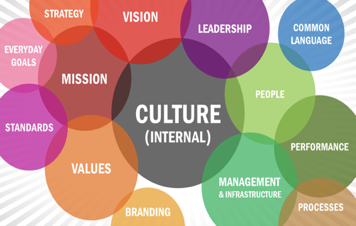
Culture is an extremely strenuous term to define. Culture is the customs, history, knowledge, physiognomies and much more shared by a particular group of people. Culture incorporates characteristics such as values, belief, art, history, traditions, languages, ethnicity, food, music and much more. Similarly, organisational culture is also understood as the fundamental beliefs and values of the people within an organisation, the way an organisation operates and the sort of customs it encompasses from within that all adds up to the social and psychological atmosphere of an organisation. One well-known American psychologist, Schein (1990) defined organisational culture as ‘shared value by people within organisation’. Organisational culture has a strong effect on the way people interact both internally and externally, meaning the way people communicate with their colleagues, staff, managers and everyone else within the organisation, along with the way they interact with customers, stakeholders.
Cultural Challenges faced by organisations:
It takes tremendous amount of efforts and time from great leaders within an organisation who contemplate, design and implement specific framework for the organisation within which it may function. This is not it, in order to ensure that all the employees and staff abide by the established system, it further takes years until each and every one who is part of the organisation adheres to the organisational culture and shares the same values and standards as the organisation itself. It is one of the most dedicated goals of any organisation to live up to its culture, maintain it and keep its employees, clients and stakeholders satisfied with its organisational culture. However, it is of utmost importance to acknowledge the need to change an entrenched culture and undergo the transition of old to new culture for an organisation to sustain. Thus, one of the most challenging tasks for an organisation is changing its culture. Organisations are always faced with the demands for change due to increased globalisation and competition. Time and again, these demands have become so challenging that they meet heavy resistance and fizzle out (Alvesson and Sveningsson, 2008).
Learning to establish, maintain and renew organisational culture is of top priority to me as I am pursuing MBA in Fashion Management and plan to open up my own boutique in the near future; belonging to fashion industry, I understand how variable and volatile this industry could get, hence the skill to adjust to changing cultures but also to be able to maintain organisational culture in a rapidly changing organisation is pertinent. According to DiDonato and Gill (2015), “most behaviour-change initiatives accomplish little, at best”, meaning that it is an extremely challenging business that involves changing people’s deep-rooted beliefs and values with an organisation.
Cultural challenges give rise to problems within an organisation:
Many organisations suffer due to not changing its entrenched culture for a longtime. An example of such a case is from the National Health Service (NHS) in the UK which faced the crisis of shortage of workforce, it faced problems in recruiting and retaining long-term staff (Finlayson, 2002). The reason as to why NHS faced this shortage is due to a few reasons such as inadequate leadership, level of stress for the staff and ambiguity in task delineating (Dixon – woods et al., 2013). All of these problems generated from one single route that led to the un-changed, deep-seated organisational culture desperately needed to be changed. NHS failed to re-shape its structure with changing times, which led to poor quality services, loss of public’s trust, unhappy staff quitting jobs, a huge gap in the recruitment of staff further leading to many other problems in the profitability, reputation and management issues of the organisation. Therefore, it is critical that the people in organisations, especially the ones at leadership positions understand the need to mend or change its culture when the time comes. Things may go south if desired amends are not made; the organisation may suffer in terms of lagging behind and losing a profitable standing to a competitor who made the cultural amends within time as demanded. Cultural changes include the changes in work process, approach towards technology, dealing with clients, working hours, interaction with employee or any other function within the organisation that affects all the stakeholders of an organisation internally and externally.
Strategies to manage culture:
Below mentioned ‘Organisational Iceberg’ demonstrates the most visible aspects to the least visible aspects, of any organisation, from top to bottom respectively. In order to manage culture within an organisation, the first and foremost step to take it to employ the most influential leaders who not only able to stay up-to-date and implement the required changes within the organisation but can also make the workforce adhere to change. As mentioned below, it is still easier to change the overt aspects of an organisations culture, as they are noticeable, hence steps could be taken to fix problems. However, it is comparatively difficult to solve problems arising due to behavioural aspects (covert), because these problems go unnoticed but have already started to poison the system long before any step could be taken. For such issues, leaders could make use of cognitive approach, which is the understanding of people regarding change in culture and strategy (Kim and Mauborgne, 2005).
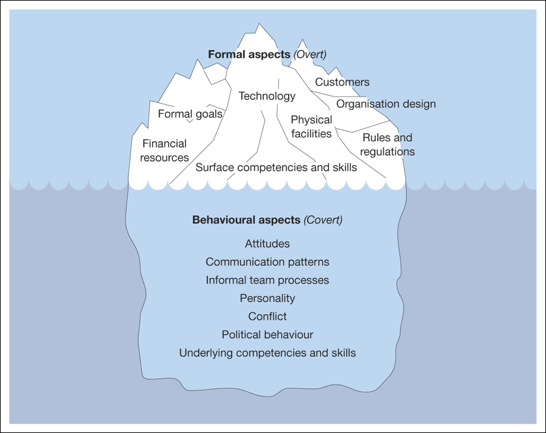
Cultures can be managed within organisations if proper leadership is incorporated and the change implemented correctly, when the need be. It is important for businesses to stay up-to-date in the recent times and follow up with the new innovations and developments. Owing to increased globalisation, trends keep changing and with that it is important for the organisations to mend their cultures in a way that agrees with the employee satisfaction level.
Reference List:
Alvesson, M. and Sveningsson, S. (2008). Changing Organisational Culture: Cultural change work in progress. London: Routledge.
DiDonato, T. and Gill, N. (2015). Changing an Organization’s Culture, Without Resistance or Blame, Harvard Business Review, Jul-Aug 2015.
Dixon-Woods, M., Baker, R., Charles, K., Dawson, J., Jerzembek, G., Martin, G., McCarthy, I., McKee, L., Minion, J., Ozieranski, P., Willars, J., Wilkie, P. and West, M. (2013) ‘Culture and behaviour in the English National Health Service: overview of lessons from a large multimethod study’, British Medical Journal Quality and Safety, 23 (2), 106-115.
Finlayson, B., Dixon, J., Meadows, S., & Blair, G. (2002). Mind the gap: the extent of the NHS nursing shortage. Bmj, 325(7363), 538-541.
Hellriegel, D., Jackson, S.E. and Slocum, J. W., Jr., Management, Eighth Edition, South-Western Publishing (1998).
Kim, W. Chan. Mauborgne, Renée. (2005) Blue ocean strategy :how to create uncontested market space and make the competition irrelevant Boston, Mass. : Harvard Business School Press.
McCalman, J. and Potter, D. (2015). Leading Cultural Change: the theory and practice of successful organisational transformation. London: Kogan Page.
Mundasad, S. (2017) More than 86,000 NHS posts vacant [online] available from< http://www.bbc.co.uk/news/health-40715955>
Schein, E.H., 1990. Organizational culture (Vol. 45, No. 2, p. 109). American Psychological Association.
Willcoxson, L. and Millett, B. (2000). The Management of Organisational Culture. Australian Journal of Management & Organisational Behaviour, 3(2) 91-99.

 Leading in a Changing World
A good write up on organizational culture. But like many cultures, it is deeply ingrained in the practitioners and time will surely and gradually evolved the cultural practices in the effluxion of time. In any cultures for that matter, the changes will experience the following stages, namely:-
1. New practices;
2. Altercation, Conflicts and disputes;
3. Acceptance;
4. Assimilation;
Just like life cycle, the practices of cultures see the generation of culture, it’s degeneration and it’s regeneration manifested in many forms.
LikeLike
Organizational cultures be it a simple company, a multinational companies or conglomerates are like human societies. It has its norms, rules & regulations, beliefs, principles and practices.
Fashion management has to be in congruence with such organizational cultures so as to keep these entities going with its evolution and continuity.
Just like the changes in cultures and organizations, societies and its norms, belief and practices also changes over time.
In view of the foregoing, nothing is therefore permanent except change. Like the changes in cultures, the norms beliefs and practices, fashions which is part of cultures also changes over time.
LikeLike
This blog defines organisation culture as the fundamental values and beliefs held by people within an organisation, which affects how it operates. It has a direct effect on how employees communicate with their colleagues and interact with customers.
LikeLike
Culture varies from one organisation to another. It is built over a period of time and must be shared by all stakeholders.
LikeLike
Indeed, it takes some time and effort for all employees and managers to adhere to the organisational culture and share its values and goals. Also, it is argued that organisations must be ready to adjust their culture to address the present challenges in the globalisation era. Your blog concludes by suggesting various strategies that can be adopted by organisation to manage the challenges that come with changes in culture which is good.
LikeLike
Thank you David. The organisation culture should be aligned to the vision and mission of an institution. In the event this is not the case, necessary adjustment should be made.
LikeLike